
The Shift Is Already Happening — Here's What's Driving It
Walk into any serious office supplies procurement conversation in Nairobi, Lagos, Accra, or Dar es Salaam right now and you'll hear the same question being worked through from different angles: why are we still buying toner through local distributors when the numbers no longer add up? It's not a new question, but something has changed in the past two to three years. More procurement teams are arriving at the same answer and actually acting on it, rather than continuing to absorb the cost differential because rerouting supply chains feels complicated.
The answer, for a growing number of African businesses, is HP toner sourcing UAE for Africa — building a direct procurement relationship with a wholesale supplier in the UAE and managing the import process themselves, rather than paying the compounded markups of a three or four-tier local distribution chain. The businesses that have made this shift are not large multinationals with dedicated import infrastructure. Many of them are mid-size resellers, regional office supply companies, and corporate procurement teams that made one decision to restructure how they buy and have been running on better economics ever since.
This article explains what's behind the shift in practical terms — the cost case, the logistics reality, the authenticity considerations, and the country-specific import factors that procurement teams in Kenya, Nigeria, Ghana, Tanzania, and Uganda need to understand before placing their first direct UAE order. It also explains where Yalla LLC fits in that picture and what a UAE-sourced supply arrangement actually looks like from the buyer's side.
If you're still buying HP toner through a local distributor and the pricing hasn't been reviewed in a year or more, the gap between what you're paying and what you could be paying has almost certainly widened since the last time you checked.
What's Wrong With Local Distribution — and Why the Problem Is Structural
The frustration with local HP toner distribution in African markets isn't primarily about individual suppliers being difficult or dishonest. Most of the people in these supply chains are doing their jobs competently. The problem is the structure itself. A product that leaves HP's regional manufacturing or distribution facility goes through an authorised regional distributor, then a national distributor, then a city-level wholesaler, then a local stockist, and finally reaches the procurement manager who actually needs it. Each of those steps exists for a reason. Each of them also adds a margin.
By the time an HP 85A cartridge has passed through four distribution layers, the procurement manager buying it is paying for the cost of warehousing it four times, the working capital financing of four separate inventory positions, the sales force of four separate companies, and the risk premium of four separate businesses that need to protect their margins against demand variation. None of this shows up on the invoice as a line item. It's just embedded in the price.
Inventory availability is the second structural failure. Local distributors stock what moves fastest and in quantities their cash flow supports. An older LaserJet model that's common in government offices and schools across East Africa — the P1606dn, the M1536dnf, the 1020 series — may still represent significant volume in aggregate, but no single local distributor has the inventory depth to service that demand reliably. Buyers calling around for CE278A stock in Nairobi or Accra on a Thursday afternoon find one stockist who has six units, another with twelve, and two more who are expecting stock 'next week.' HP toner sourcing UAE for Africa solves this problem at the root — a serious UAE wholesale supplier carries stock depth that no local distributor in any single African market can match.
Then there's the authenticity problem, which is real and which gets worse as you move further down the local distribution chain. Counterfeit HP toner is a significant market presence across West and East Africa. The economics of counterfeiting are unfortunately compelling at the volumes these markets consume. Fake cartridges have improved in external appearance to the point where visual inspection alone isn't reliable. The consequences — printer drum damage, inconsistent yield, client complaints, returns — are expensive relative to whatever was saved on the cartridge price. Shorter, more transparent supply chains are meaningfully harder to contaminate with counterfeit product than longer, less-documented ones.
Why the UAE Specifically — and Not Europe, Asia, or Anywhere Else
The question is reasonable. If the problem with local African distribution is supply chain length and markup accumulation, why is the UAE the answer rather than sourcing directly from HP's manufacturing base in Asia, or from European distributors who operate at scale? The answer sits at the intersection of geography, trade infrastructure, inventory depth, and the practical logistics of moving goods to African ports.
Geography is the foundation. Jebel Ali Port in Dubai is the largest port in the Middle East and among the busiest globally. It sits at the natural junction of shipping lanes connecting Asia, Europe, and Africa — which means the freight routes from Dubai to East and West African ports are well-established, high-frequency, and competitively priced. The transit time from Jebel Ali to Mombasa is 10 to 14 days by sea. To Lagos it is comparable. To Dar es Salaam and Tema it is slightly longer but still within a range that supports a 60-day procurement cycle comfortably. Sourcing from Asian manufacturing hubs adds transit time and typically requires minimum order volumes that don't suit the procurement patterns of most African resellers and importers.
The UAE's free zone trade infrastructure amplifies the geographic advantage. Businesses operating from JAFZA, DAFZA, and other Dubai trade zones face minimal export friction, competitive warehousing costs, and access to freight forwarding networks with deep experience on the African trade lanes. The regulatory environment is designed to facilitate re-export trade, which is precisely the commercial model that HP toner sourcing UAE for Africa relies on. European distributors, by contrast, operate under VAT frameworks and export procedures that add complexity and cost to African-bound shipments without providing compensating price advantages.
Inventory depth is the practical clincher for most African buyers who've looked at the alternatives seriously. Dubai's HP toner wholesale market carries current-generation LaserJet and Color LaserJet stock alongside models that have been out of production for five to ten years but remain in active use across African offices. The CF226A, CE285A, CE278A, Q2612A, CF258A — and the older Q2613A and C4127X for institutions running genuinely legacy printer fleets — are available in the volumes African importers need, without the minimum order constraints that manufacturer-direct or European distributor sourcing tends to impose.
|
Factor |
Local African Distributor |
UAE Wholesale (Yalla LLC) |
Why It Matters |
|
Price per unit |
3–4 markup layers baked in |
Wholesale direct, 1–2 layers |
30–50% unit cost difference on volume |
|
Inventory depth |
Limited, model-specific gaps |
Full HP range, all generations |
No stockout risk on common models |
|
Authenticity assurance |
Variable, chain-dependent |
HP-authorised, documented |
Eliminates counterfeit risk |
|
Stock availability |
Reactive, often inconsistent |
Forward-allocated on contract |
Supports planned procurement cycles |
|
Lead time |
1–7 days locally |
15–25 days incl. shipping |
Requires forward planning |
|
Documentation |
Minimal for local purchases |
Full export/import docs included |
Needed for customs clearance |
|
Price on aged models |
Often unavailable locally |
Available, competitive |
Keeps older fleets running cheaply |
The one column in that table where local distribution has a genuine advantage is lead time. A procurement manager who runs out of toner on a Monday morning and needs it by Tuesday afternoon is not being served by a UAE wholesale arrangement. That's a reality of direct import procurement — it requires forward planning and a reorder cycle that's measured in weeks, not days. The buyers who make this model work successfully are those who've shifted from reactive to planned procurement, which is a change in operating practice as much as a change in supplier.
The Cost Case: What the Numbers Look Like in Practice
Abstract claims about cost savings are easy to make and hard to evaluate. The comparison that matters is landed cost — the price the cartridge actually costs you in your warehouse in Nairobi or Lagos, inclusive of product cost, freight, import duty, customs clearance, and all associated handling fees — versus what you currently pay your local distributor.
Take the HP 26A (CF226A) as a reference point, a model with consistent demand across corporate and government printer fleets in East and West Africa. A local distributor in Nairobi currently prices genuine HP 26A stock at approximately KES 4,200 to KES 5,100 per unit depending on relationship and quantity. In Lagos, the equivalent NGN pricing reflects a similar dynamic — multiple markup layers producing a retail-to-wholesale spread that a direct import arrangement eliminates.
|
Illustrative Cost Comparison: HP 26A (CF226A) — 100 Units to Nairobi → Local distributor price (Nairobi): KES 4,400/unit × 100 = KES 440,000 → Yalla LLC UAE wholesale price: approx. USD 14.50/unit × 100 = USD 1,450 → Sea freight Jebel Ali–Mombasa (LCL, 100 units): approx. USD 185 → Kenya import duty (25% on CIF): approx. USD 409 → VAT (16% on CIF + duty): approx. USD 302 → Clearing agent + port handling: approx. USD 180 → Inland transport Mombasa–Nairobi: approx. USD 95 → Total landed cost: approx. USD 2,621 (KES ~341,730 at current rates) Saving vs local distributor: approx. KES 98,270 on 100 units — 22% reduction Annualised (400 units/year): saving of approx. KES 393,000 |
The saving in this illustration is real but not dramatic at 100 units. At 300 units per order — a quarterly procurement cycle for a mid-size reseller or a large corporate account — the per-unit freight economics improve significantly, the clearing agent fee is spread across more units, and the total saving widens to 28 to 35 percent on landed cost. That's the level at which HP toner sourcing UAE for Africa changes the fundamental economics of a reseller's business model, rather than just trimming the margins slightly.
Nigerian importers face a different cost structure: import duty on printer consumables sits at 10%, and the naira's volatility means dollar-denominated procurement requires careful FX management. But the unit cost saving from UAE wholesale versus Nigerian local distribution is typically larger in absolute dollar terms than in Kenya, because local Nigerian distribution markup layers are steeper. Procurement teams in Lagos who have modelled this seriously consistently find the landed cost comparison compelling at volumes above 150 units per order.
Ghana and Tanzania present broadly similar economics to Kenya, with country-specific variations in port efficiency (Tema Port has improved materially over the past three years), duty rate structures, and clearing agent market depth. The fundamental calculation — UAE wholesale price plus total logistics cost versus local distributor price — favours the UAE route at meaningful order volumes in all five markets covered in this article.
Import Realities Country by Country
The UAE-to-Africa supply route is well-established but not uniform. Each country has its own customs authority, import duty structure, port infrastructure, and documentation requirements. A procurement team sourcing HP toner for the first time through this channel needs to understand the specific landscape at their destination, not just the Dubai end of the transaction.
|
KENYA |
Kenya is the most mature market for UAE toner imports among the five countries covered here. The import route is well-worn: Jebel Ali to Mombasa (ICD or Kilindini Harbour), clearance through Kenya Revenue Authority, then road to Nairobi or onward distribution. Import duty on printer consumables sits at 25% — the highest in this group — and VAT at 16% makes Kenya's landed cost addition among the most significant in East Africa. The upside is that clearing agents in Mombasa with UAE trade experience are numerous and competitive, documentation turnaround is relatively fast for experienced importers, and the overland Mombasa-to-Nairobi transit is predictable.
Kenya Revenue Authority has strengthened product authenticity and compliance checks on electronics and consumables imports over the past two years. Having HP authenticity documentation — manufacturer certificates, supply chain provenance from an HP-authorised distributor — available as supporting documentation is increasingly important for smooth clearance rather than a nice-to-have. Yalla LLC provides this documentation as standard on all orders.
|
NIGERIA |
Nigeria's import environment requires more operational attention than Kenya's, but the market scale makes it worth the effort. Port congestion at Apapa has been an ongoing challenge, though Tin Can Island Port provides a practical alternative for Lagos-bound shipments and has shown improved processing times. Import duty on printer consumables is 10%, with a 7.5% VAT rate. The Combined Expatriate Residence Permit and Aliens Card (CERPAC) requirements don't affect commercial imports, but NAFDAC and SON certification questions occasionally arise on electronics-adjacent products — having a local customs broker experienced in printing consumables imports is important for smooth clearance.
Currency management is a real consideration for Nigerian importers. The naira's performance against the dollar has created a more complex FX calculation than it was three years ago. Buyers paying in USD through international transfer need to plan the FX conversion into their cost model rather than treating the exchange rate as fixed. Some Yalla LLC Nigerian clients structure their procurement on a rolling FX hedge basis — buying forward when the rate is favourable and building inventory accordingly.
|
GHANA |
Ghana's import infrastructure has improved noticeably with the upgrade and expansion of Tema Port. Transit times from Jebel Ali to Tema run 16 to 20 days by sea, slightly longer than East African routes, which requires a 25 to 30 day planning window from order to warehouse. Import duty on printer consumables is 10%, with a 15% VAT rate. The Ghana Revenue Authority has been consistent in documentation requirements, and importers with established customs broker relationships report predictable clearance timelines for clean shipments.
The Ghanaian office supplies market has a significant reseller network across Accra, Kumasi, and secondary cities, making it one of the stronger markets for HP toner sourcing UAE for Africa at the reseller tier. Procurement teams buying for distribution rather than for direct corporate use tend to find the bulk economics compelling at lower minimum quantities than in some other markets, because the onward margin structure in Ghana's reseller market allows UAE-sourced stock to be priced competitively against locally distributed product while maintaining meaningful margin.
|
TANZANIA |
Tanzania is served by Dar es Salaam Port, which handles the majority of commercial imports, and increasingly by the Dar es Salaam-Zambia rail link and road corridors for landlocked onward distribution. Import duty on printer consumables is 10%, and Tanzania applies a 18% VAT rate — the highest in this group — which makes landed cost calculation particularly important to get right before pricing is confirmed to end customers. The Tanzania Revenue Authority has been systematic about documentation completeness, and shipments missing certificate of origin or accurate HS code classification face delays that can add two to five days to clearance.
For buyers serving both Tanzania and Uganda from a single import arrangement, Dar es Salaam is the natural gateway for Tanzania-destined stock, while Mombasa remains the preferred gateway for Uganda and Rwanda onward distribution. Some importers split orders between the two ports based on destination rather than consolidating everything through one gateway — a structural choice that depends on order volume and the relative cost of onward inland freight from each port.
|
UGANDA |
Uganda is a landlocked market served primarily through Mombasa Port and the Northern Corridor road transit to Kampala. The additional overland leg from Mombasa adds three to five days and approximately USD 150 to 250 per consignment in transit costs, which needs to be in the landed cost model. Import duty on printer consumables is 25%, and Uganda applies a 18% VAT rate, making it — alongside Tanzania — one of the higher tax-add markets in this group. The Uganda Revenue Authority clearance process has improved with digitalisation, but the port-to-Kampala transit adds a variable that Kenyan buyers don't face.
Despite the higher per-unit landed cost relative to markets with direct sea access, Uganda-based procurement teams consistently find the UAE sourcing model financially compelling because local distribution markups in Kampala are high enough to absorb the additional freight cost and still leave significant unit cost savings at 50+ unit order volumes. Yalla LLC has active supply relationships with Kampala-based office supplies businesses and can advise on the specific freight forwarder and clearing agent combinations that produce the most reliable Mombasa-to-Kampala transit.
Authenticity: Why Shorter Supply Chains Produce Better Outcomes
The counterfeit HP toner problem in African markets is not exaggerated, and it doesn't get better as you move further from the manufacturer's supply chain. The economics of counterfeiting are driven by volume and margin — markets that consume large quantities of a few high-demand models are exactly the environments where counterfeit product proliferates. The HP 85A, 78A, and 12A are the three highest-volume cartridges in most African markets. They are also, not coincidentally, the three models with the highest counterfeit prevalence.
A procurement team buying through a four-tier local distribution chain has limited visibility into what happened to the product between the authorised regional distributor and the stockist they're buying from. Each hand-off is a potential entry point for substitution, and the documentation trail that would allow provenance verification often doesn't exist or isn't requested. The buyer receives stock that looks correct, prices it to their clients, and finds out months later — through a cluster of printer complaints, premature yield failures, or a client whose drum has been damaged — that the product wasn't what it appeared to be.
HP toner sourcing UAE for Africa through an authorised wholesale supplier compresses the supply chain to two steps: HP's authorised regional distributor to Yalla LLC, and Yalla LLC to the African buyer. At two steps, provenance documentation is straightforward to maintain and verify. Yalla LLC provides HP supply chain documentation on every order — the authorisation records and distribution chain verification that allow a procurement team to demonstrate to their own clients that the product is genuine. For corporate accounts and government procurement offices that require authenticity certificates as a condition of purchase, this documentation is the difference between winning and losing the tender.
|
Verification Method |
What It Checks |
How to Use It |
Reliability |
|
HP Authentication App |
Chip encoding vs HP database |
Scan cartridge chip with phone |
High — immediate pass/fail |
|
Holographic label |
Physical security features |
Inspect under close light |
Medium — sophisticated fakes improving |
|
Supply chain docs |
Authorised distributor chain |
Request from supplier pre-order |
High — hard to fabricate convincingly |
|
Page yield test |
Actual vs rated performance |
Track pages per cartridge installed |
Medium — some fakes pass early, fail late |
|
HP Smart app |
Cartridge registration check |
Add cartridge in HP Smart portal |
High — direct HP database query |
The verification protocol that matters most for bulk procurement is the supply chain documentation check — done once, before the order is confirmed, it covers the entire batch. Physical verification methods are useful for spot-checking on receipt, but running HP Authentication App checks on 200 cartridges from a single order is impractical. Establishing that the supplier's stock traces to an HP-authorised source, documented before you pay, is the procedural control that protects bulk orders from the authenticity risk that individual unit checks can't practically provide.
How African Procurement Teams Are Actually Making This Transition
The transition from local distribution to UAE direct sourcing is not a one-day decision. The procurement teams that have navigated it most smoothly have generally followed the same sequence, whether or not they planned it that way.
The first step is the cost model. Before approaching any UAE supplier, build the full landed cost comparison for your highest-volume HP toner models. Use your current local distributor price as the baseline. Research UAE wholesale indicative pricing — Yalla LLC publishes indicative pricing for resellers and will provide specific quotes on request. Apply your country's import duty, VAT, estimated sea freight, and clearing costs. If the landed cost comparison is compelling at your current order volumes, proceed. If the volumes are too low to make the economics work, calculate what order size closes the gap and assess whether you can realistically get there.
The second step is supplier qualification. Not all UAE toner wholesalers are built for African export. The questions that matter: How many shipments to your specific country have they processed in the past twelve months? Who are their freight forwarding partners on the relevant trade lane? Can they produce HP supply chain documentation? Are they set up to handle the payment structures — TT transfers, letters of credit — that cross-border trade requires? What is their minimum order quantity, and is there flexibility for a first trial order?
The third step is the trial order. Run a smaller first order — enough to validate the product quality, the logistics process, the documentation, and the clearing agent performance at your destination port — before committing to full quarterly volume. Build the relationships at both ends of the chain: your UAE supplier and your local clearing agent need to have communicated before the first shipment, not after it arrives at port with incomplete documentation.
|
Transition Checklist: Moving to UAE-Direct HP Toner Sourcing → Build full landed cost model before approaching suppliers → Confirm import duty and VAT rates for your specific country → Identify and brief a clearing agent at your destination port → Request HP supply chain documentation from shortlisted suppliers → Confirm regional variant specification (MEA-spec for sub-Saharan Africa) → Agree part number specification in writing on purchase order → Place trial order at 30–40% of intended quarterly volume → Track actual landed cost against model on first shipment → Calibrate reorder cycle based on actual transit + clearance times → Scale to full quarterly volume once process is validated |
The fourth step — which most procurement managers underestimate — is adjusting internal reorder processes. A direct UAE import arrangement requires a forward procurement horizon of four to six weeks minimum. That means the internal process for identifying when to reorder needs to shift from 'check the storeroom when someone asks' to a structured inventory monitoring process with a defined reorder point. This is operational change management as much as procurement change, and it's the piece that most often determines whether the cost savings of direct import actually materialise in practice.
What Working With Yalla LLC on Africa-Bound Procurement Looks Like
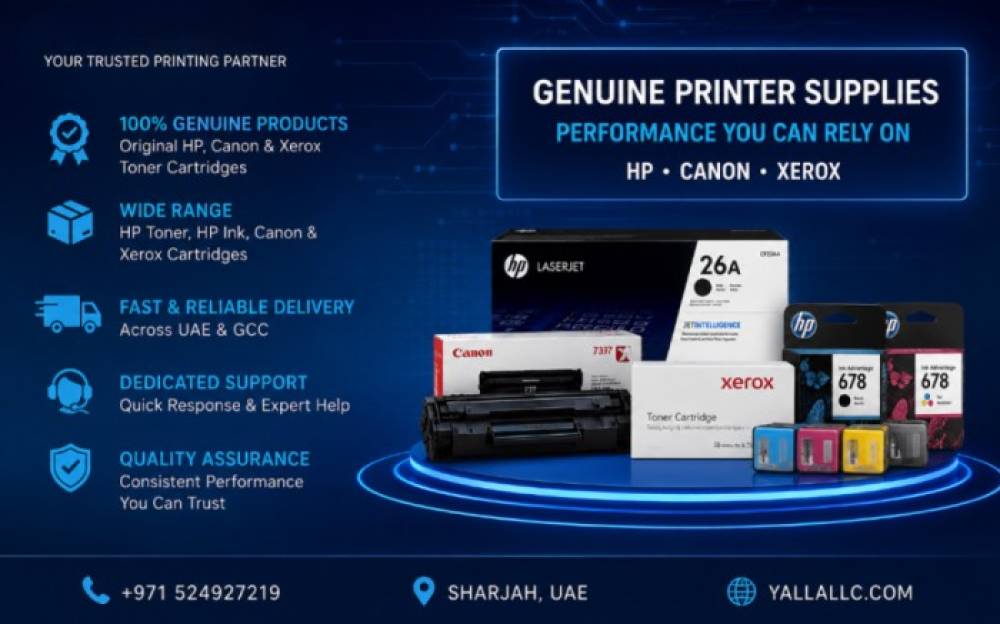
Yalla LLC structures its African supply relationships around the realities that make or break this model for buyers on the continent. The product range covers HP's full laser toner portfolio — current-generation W-series and CF-series alongside the older CE and Q-series models that remain in heavy use across government and SME printer fleets in all five markets. Regional variant is documented as MEA-spec as standard for African orders, and supply chain documentation tracing back to HP-authorised sources is provided on every shipment.
The export infrastructure is built for the African trade lanes specifically. Yalla LLC works with freight forwarding partners who run regular consolidated services to Mombasa, Apapa, Tema, Dar es Salaam, and other major African ports — which means LCL options are available for buyers who aren't filling a full container, and FCL pricing is available for larger volumes. For buyers managing procurement across multiple African countries, consolidated orders shipped to multiple destinations are structured into the commercial arrangement from the start rather than handled as exceptions.
Payment structures are configured for cross-border trade. TT wire transfer, letters of credit for larger orders, and in some cases escrow arrangements for new buyer relationships are all supported. The first order process is designed to be thorough — documentation confirmed, specifications agreed in writing, freight arrangement confirmed before invoice — precisely because getting the first shipment right establishes the template for everything that follows.
HP toner sourcing UAE for Africa through Yalla LLC is not a transactional arrangement where you send an inquiry and receive a price list. It's a supply relationship built around understanding your fleet, your volumes, your destination country's import requirements, and your procurement cycle — and making sure the arrangement is structured to serve all of those requirements consistently, not just on the first order.
The Structural Shift Is Underway — The Question Is Whether You Move With It
The procurement teams across East and West Africa who made the shift to UAE-direct HP toner sourcing two or three years ago are now operating with a structural cost advantage over competitors who are still buying through local distribution. That advantage compounds: lower unit cost means better margins or more competitive pricing, better margins enable larger orders which unlock better wholesale pricing, and larger orders at planned intervals build the kind of supplier relationship that provides stock allocation priority when supply is tight.
The shift is not for every business. It requires forward planning, import process management, and working capital to fund larger periodic orders rather than smaller frequent ones. For businesses that are growing into this model rather than already there, the calculation is about where the break-even volume sits and how quickly operations can be scaled to reach it.
For businesses that are already there — moving meaningful volumes, serving multiple clients, managing HP toner procurement as a significant cost line — the continued reliance on local distribution is a choice to overpay for a convenience that the operational investment in direct sourcing renders unnecessary. HP toner sourcing UAE for Africa through a qualified wholesale partner is the procurement model that the cost arithmetic supports. The question is not whether it works. The question is whether your operation is ready to run it.
Yalla LLC is the conversation to have before the next order cycle.
Frequently Asked Questions
Q1: What is the minimum order quantity for HP toner imports from the UAE to African countries?
There is no universal minimum that applies across all products and all markets, but the practical floor for making the economics work is typically 50 to 80 units of a single cartridge model, or equivalent mixed-model volume, when shipping to East African ports. West African destinations have slightly higher freight overhead, which pushes the economic break-even point toward 80 to 120 units. Yalla LLC offers LCL (less-than-container-load) consolidated shipping for buyers at these volumes, which allows access to wholesale pricing without needing to fill a full container. For buyers with lower initial volumes, a mixed-model order combining HP 85A, 78A, 26A, and other high-demand models into a single shipment can reach the economic threshold even when individual model volumes are modest.
Q2: How long does it take for HP toner to arrive from the UAE to East or West Africa?
Sea freight from Jebel Ali to Mombasa typically runs 10 to 14 days in transit. Customs clearance at Mombasa adds three to seven business days for clean documentation, plus two to three days for inland transport to Nairobi. Total door-to-warehouse time is approximately 18 to 25 business days for Kenya. For West Africa — Lagos and Accra — sea transit is 16 to 20 days, with clearance and inland delivery adding similar time. Total planning window from order confirmation to warehouse receipt should be four to five weeks minimum. Air freight is available for urgent orders and cuts transit to three to five days, but at freight costs that significantly erode the wholesale price advantage and are only justifiable for high-value urgent top-ups rather than routine bulk procurement.
Q3: How do I verify that HP toner from a UAE supplier is genuine before placing a large order?
The most effective pre-order verification is supply chain documentation — ask the supplier for records demonstrating that their HP stock is sourced from HP-authorised distribution channels. This means an HP distributor authorisation letter, distributor purchase records from a recognised HP regional wholesale operation, or equivalent documentation that creates a documented chain between the manufacturer's authorised network and the supplier you're buying from. Yalla LLC provides this documentation as standard. Physical verification on receipt — HP Authentication App chip scan, holographic label inspection — is the appropriate second layer for spot-checking on delivery. Any supplier who deflects or delays on supply chain documentation requests before an order is placed is providing a useful signal about the risk profile of their stock.
Q4: What import duties and taxes should I budget for in Kenya, Nigeria, Ghana, Tanzania, and Uganda?
Import duty on printer consumables varies: Kenya applies 25%, Nigeria 10%, Ghana 10%, Tanzania 10%, and Uganda 25%. VAT rates on top of landed cost: Kenya 16%, Nigeria 7.5%, Ghana 15%, Tanzania 18%, Uganda 18%. These figures are current as of mid-2026 but should be verified with a local customs broker before finalising landed cost models, as GCC and African tax policy continues to evolve. As a rough planning rule, add 35 to 55 percent on top of your UAE FOB price to estimate landed cost in East African markets, and 28 to 45 percent for West African markets — with the lower end of each range applying to larger shipments where per-unit freight and clearing costs are lower.
Q5: Can Yalla LLC ship HP toner to multiple African countries in a single order arrangement?
Yes. Yalla LLC structures multi-destination African supply arrangements for buyers managing procurement across multiple markets. A procurement team sourcing for Kenya, Uganda, and Tanzania simultaneously, for example, can consolidate purchasing into a single commercial arrangement with Yalla LLC while shipping to separate destination ports. This approach allows bulk pricing to be applied to total order volume rather than per-country volumes, which improves the economics for buyers whose individual country volumes are below the optimal threshold. Documentation is handled separately per destination to reflect each country's specific customs requirements. Discuss your specific distribution footprint with Yalla LLC directly to structure the arrangement that fits your operation.
Q6: What makes Yalla LLC different from other UAE-based HP toner wholesalers for African buyers?
The primary differentiators for African procurement are the ones that make the import process reliable rather than speculative: documented HP-authorised supply chain, MEA-spec regional variant as standard, freight forwarding partners with established African trade lane experience, documentation packages built for each destination country's customs requirements, and a commercial structure that accommodates the payment methods and order sizes realistic for African importers at different stages of scaling their import volume. Many UAE toner wholesalers serve strong GCC domestic demand and have limited operational depth on African export. Yalla LLC's active supply relationships across Kenya, Nigeria, Ghana, Tanzania, and Uganda mean the African-specific knowledge — which clearing agents to use, what documentation customs authorities are currently scrutinising, which freight routes are performing reliably — is current and operational, not theoretical.