
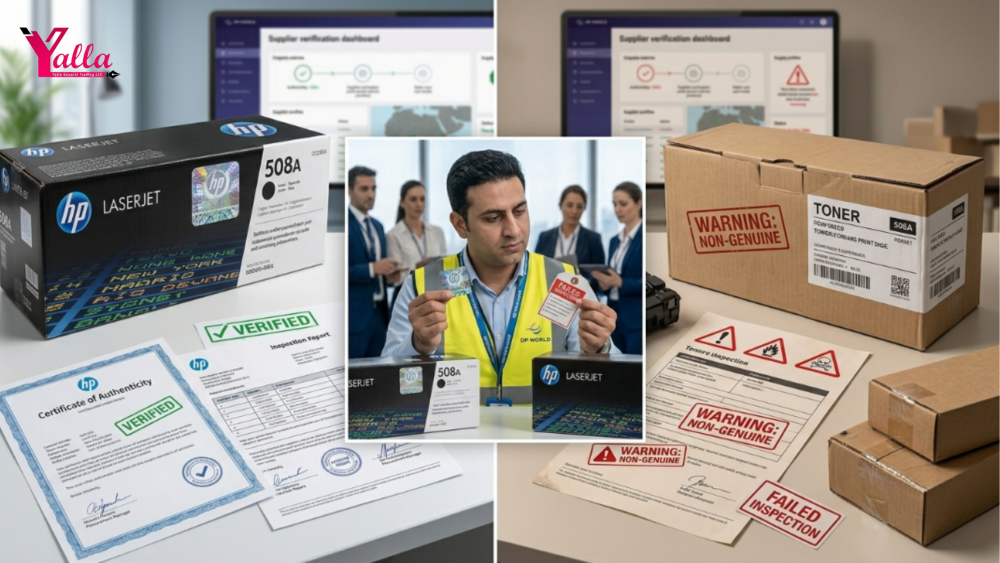
That Invoice Looked Fine. The Toner Wasn't.
A procurement officer in Accra once told me his company had been buying from the same Dubai trader for nearly two years before anyone noticed the printers were degrading faster than they should. The cartridges printed fine for the first few hundred pages. After that — streaking, faded output, one machine pulling paper unevenly. The repair technician spotted the problem immediately. Fake toner. Substandard powder that left residue on the fuser roller over time.
Two years. Dozens of shipments. The trader had decent English, a professional-looking website, and he always responded within 24 hours. He just wasn't selling what he said he was selling.
That story isn't unusual. Anyone who's spent real time sourcing wholesale printer cartridges in the UAE wholesale market will tell you the same thing — the market has extraordinary depth, it moves fast, and the gap between a legitimate authentic HP toner supplier and a convincing fake one is not always obvious on first contact.
This guide is a working checklist for purchase managers who want to verify genuine HP toner suppliers in the UAE before money moves and cargo ships.
What Counterfeit Toner Actually Does to Your Business
People tend to frame counterfeit toner as a print quality problem. That's the least of it.
The bigger issue is mechanical. HP cartridges are engineered to precise tolerances — the toner particle size, the chemical composition, the fusing temperature range. Knock-off powder doesn't match those specs. It may print adequately at first, then begin leaving behind deposits inside the printer's drum unit and fuser assembly. By the time the damage shows up as visible print defects, the internal components are already worn. You're looking at repair bills — or replacement units.
HP's warranty terms are unambiguous on this point. Damage caused by non-genuine consumables isn't covered. A company running 30 or 40 networked printers that loses warranty coverage on the fleet because of fake cartridges has a serious cost exposure that has nothing to do with the original toner price.
Then there's the client side. If you're a reseller supplying offices in Lagos, Kampala or Johannesburg, your clients aren't reading cartridge batch codes. They're printing contracts, reports, proposals. When print quality degrades or a machine goes down, they call you. Reputational damage in trade reselling is sticky — it takes far longer to recover than the margin you saved on a cheaper shipment.
The UAE Market Is Huge. That's part of the problem.
There's a reason so many African importers source HP toner wholesale from the UAE — the pricing is competitive, the logistics infrastructure is excellent, and the sheer volume of available stock means you can usually fill mixed orders without long lead times. Dubai in particular has built a re-export ecosystem that genuinely works.
But scale cuts both ways. The same trading districts—Deira, Al Quoz, Sharjah's industrial zones — that house legitimate HP toner distributors Dubai-side also host grey importers, parallel traders, and outright counterfeit operations. They share the same postal codes. They sometimes share the same buildings. A WhatsApp message and a PDF invoice don't tell you which category your supplier falls into.
The challenge for buyers in Kenya, Nigeria, Tanzania, Ghana or Uganda is that they can't easily visit. Most of these procurement relationships are conducted entirely remotely. That distance is exactly what bad suppliers exploit. To properly verify genuine HP toner suppliers in the UAE, you need a structured process — not just instinct and a few good email exchanges.
Red Flags That Get Rationalised Away
Experienced purchase managers know what warning signs look like. They rationalize them anyway. Usually because of a deadline, a budget shortfall, or the sunk cost of having already communicated with a supplier for three weeks.
The price seems too good. This one gets explained away constantly. "Maybe they have warehouse overstock." "Maybe their margins are just tight." Genuine HP toner distributors operate within a cost structure. Authorised distributors especially — their agreements with HP come with pricing floors. A supplier offering bulk toner purchase in Dubai at 40 to 50 percent below what comparable suppliers quote is either moving grey market product or counterfeit. There's no other explanation that holds up.
They can't or won't show a trade licence. Every real business in the UAE — free zone or mainland — holds a current trade licence from the relevant authority. It's a basic document. Any legitimate HP toner wholesale UAE operator will share it without hesitation. Deflection, delays, or offers to "send it later" are a signal.
Export paperwork is vague. Serious exporters know documentation. Certificate of origin, commercial invoice format, packing list, HP authorisation letters where applicable. Suppliers who get vague when you ask specific questions about export documents either haven't done it properly before, or they don't want scrutiny on what's in the boxes.
No physical footprint you can verify. A phone number, a WhatsApp contact, and a Hotmail address do not constitute a verifiable supplier. If there's no address you can cross-reference on Google Maps with a real warehouse or trading unit, proceed very carefully.
Payment pressure. Urgency around payment — "price only valid for 48 hours," requests for transfer to personal accounts, discomfort with standard trade terms — these don't come from legitimate wholesale businesses operating at volume.
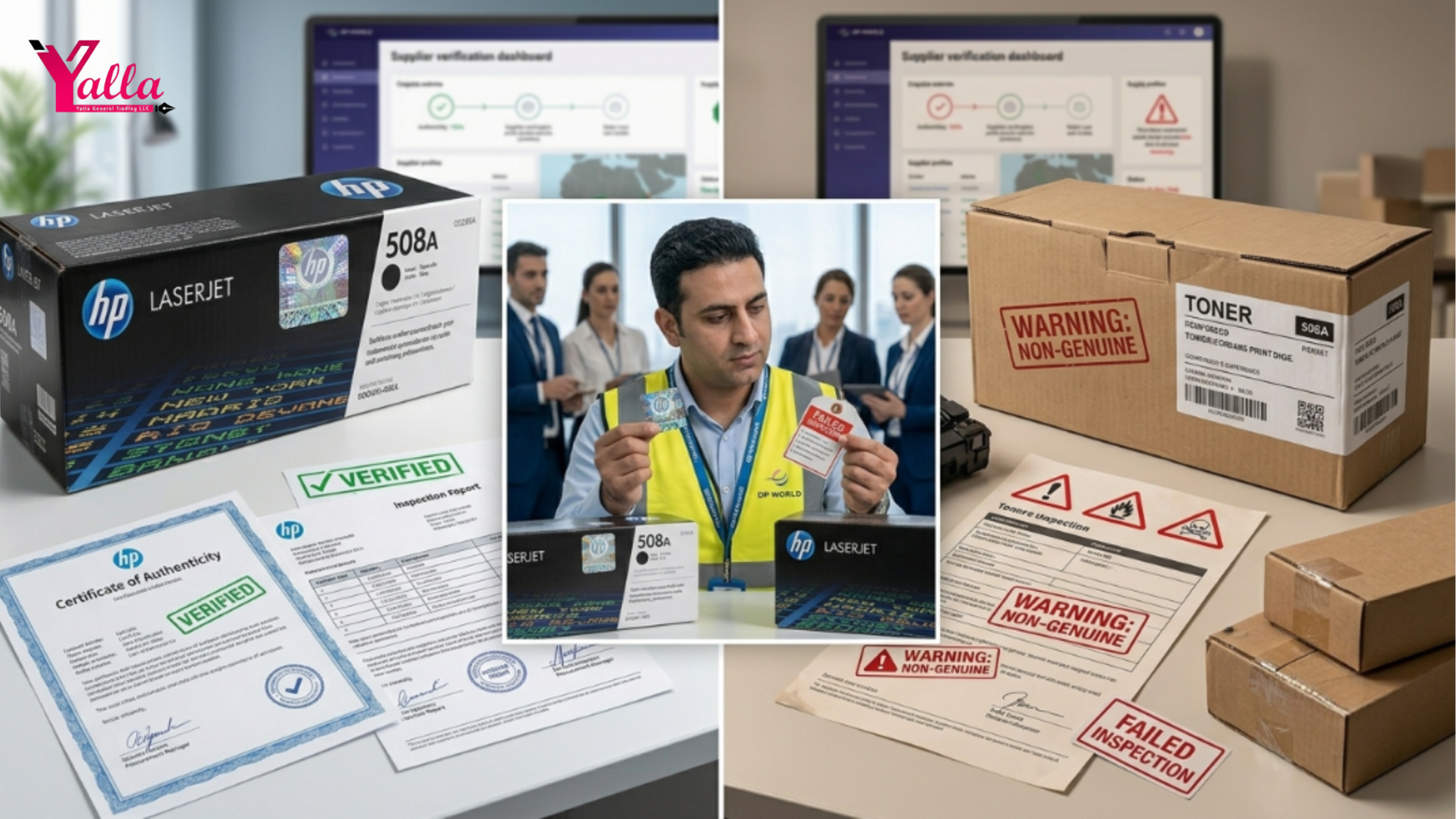
The Checklist: How to Verify Genuine HP Toner Suppliers in the UAE
Work through these in order. Don't compress the process because a supplier seems credible.
Trade Licence Check Ask for the UAE trade licence number and verify it yourself through the relevant government portal — Dubai Economy's DED platform, JAFZA's directory, or whatever free zone authority applies. You want to confirm the licence is active, covers the right business category (trading in office consumables or electronics), and that the registered company name matches the entity on your invoice.
HP Authorisation Status Ask the supplier directly whether they hold HP distributor or reseller authorisation. Genuine HP toner distributors will have documentation for this. HP also maintains a partner locator you can cross-reference. Being unauthorised doesn't automatically mean a supplier is selling counterfeits — some legitimate traders source through secondary wholesale channels — but if they're unauthorised they should be able to explain their supply chain clearly and without evasion.
Batch Code and Serial Verification HP's authentic cartridges carry batch codes and serial numbers that can be checked through HP's product authentication portal. Before you commit to volume, ask for photos of product packaging that show these codes. Once samples arrive, check the codes yourself online. This step alone will catch a high percentage of fakes.
Packaging Inspection Genuine HP packaging has specific security features — holographic authentication labels, crisp print quality on box surfaces, model-specific labelling that matches the actual cartridge inside. Fakes often get the big things right but slip on details: colour tones that are slightly off, label fonts that don't match, sticker placement that doesn't align with HP's standard. If you have a genuine HP box for comparison, use it.
Sample Order Before Volume Non-negotiable. Order 5 to 10 units before placing any container-level quantity. Run them through the actual printer models your clients use. Check page yield against HP's published spec sheet for that cartridge. Inspect output quality at the start, middle, and near end of cartridge life. This is the one test that can't be faked.
Warehouse or Third-Party Inspection For container-load orders, the cost of hiring a third-party inspection agency in Dubai is trivial against the shipment value. Agencies like SGS, Bureau Veritas, or smaller local firms can conduct a pre-shipment inspection — verifying quantities, checking packaging condition, pulling random cartridges for visual authentication. If your supplier resists this, that itself is your answer.
References From African Buyers Ask for two or three references from buyers in your region. A supplier who regularly handles toner export to Africa will have clients in Kenya, Nigeria, Tanzania, or Ghana they've worked with over multiple shipments. Contact those references. Ask specifically about authenticity, documentation accuracy, and how disputes were handled.
Invoice and Documentation Clarity Your final commercial invoice should list HP model numbers in full, quantities per SKU, unit pricing, and declared country of origin. Vague descriptions like "printer consumables — mixed" or "office supplies" cause customs problems at destination and give you no paper trail if there's a dispute. Suppliers who push back on specific invoicing are not suppliers you want.
Why Dubai Specifically
The question sometimes comes up — why not source directly from manufacturers in China, or from distributors in Europe?
The honest answer is that Dubai's re-export infrastructure makes it genuinely competitive for African import buyers. Jebel Ali is among the best-connected container ports in the world, with reliable shipping lanes to Mombasa, Dar es Salaam, Lagos, Tema, and Durban. Free zones like JAFZA and DAFZA give traders the ability to import, hold stock, and re-export without the friction that other jurisdictions impose. Freight consolidation services are well-developed, which matters enormously for buyers who aren't filling full containers.
For HP toner suppliers Dubai-based distributors also tend to hold broader SKU ranges than typical country-specific distributors. If you're sourcing for a reseller operation serving mixed printer fleets — HP LaserJet, MFPs, OfficeJet Pro — a single Dubai supplier can often consolidate what would otherwise require three or four separate sourcing relationships.
The wholesale printer cartridges UAE market has genuine depth. The problem is not with the market. It's with not verifying who you're buying from inside it.
Practical Notes for African Importers
A few things that come up repeatedly in sourcing conversations with buyers in East and West Africa.
MOQ flexibility is real but you have to ask for it. Most suppliers have published minimum order quantities, but those numbers move for buyers who've established a relationship. If you're ordering across eight or ten cartridge models, ask about mixed pallet arrangements — many suppliers will accommodate this rather than lose the total order value.
Freight consolidation saves money that's easy to miss in initial cost comparisons. If your order doesn't fill a 20-foot container, a consolidator working regular Dubai-to-Africa routes can bring your per-carton shipping cost down substantially. Get the total landed cost figure — not just FOB — before comparing supplier quotes.
On payment, a 30/70 structure (30 percent advance, 70 percent against bill of lading) is standard for established relationships. For a first order with a new supplier, you may need to negotiate harder. Letters of credit are available for larger transactions and offer both parties some protection. Avoid full upfront payment until you have at least two clean deliveries on record.
Shelf life matters more than many buyers realise. HP toner cartridges have a nominal shelf life of around 24 months from manufacture date. Ask for production dates on the batch before ordering, especially if you're building inventory ahead of a long selling season. Receiving a shipment that's already 18 months old gives you very little time to move it.
The Mistakes That Keep Happening
The same errors show up consistently, even among experienced procurement teams.
Selecting a supplier based on price alone. The cheapest quote in the UAE is not the best quote. Total cost of ownership — including potential printer damage, warranty issues, and customer complaints — needs to factor into the calculation.
Confusing a fast communicator for a reliable supplier. Response speed is a sales tactic. It says nothing about whether the product is genuine.
Treating the sample as a formality. Some buyers order samples, print a page or two, and consider the box checked. Real sample testing means running cartridges to near-depletion and testing yield properly.
Assuming the first shipment proves the relationship. The first shipment is sometimes the best one. Scrutinise every shipment, particularly after a supplier relationship has been running for six months or more.
Building Something That Lasts
The real goal here isn't just to verify genuine HP toner suppliers in the UAE on a one-time basis. It's to identify two or three suppliers who can be trusted consistently, and to build procurement processes that keep working as your volumes grow.
The UAE wholesale market is not static. Distributors change hands, authorisation agreements shift, new players enter the market. A supplier who was solid 18 months ago may have changed their sourcing. Annual re-verification of key suppliers — trade licence check, fresh sample order, updated references — is not overcautious. It's what serious purchasing operations do.
For African importers managing reseller networks, the ability to confidently verify genuine HP toner suppliers in the UAE is a competitive edge. Your clients aren't just buying toner from you. They're buying the assurance that what arrives is what it says it is. That trust, once built, is worth protecting.