
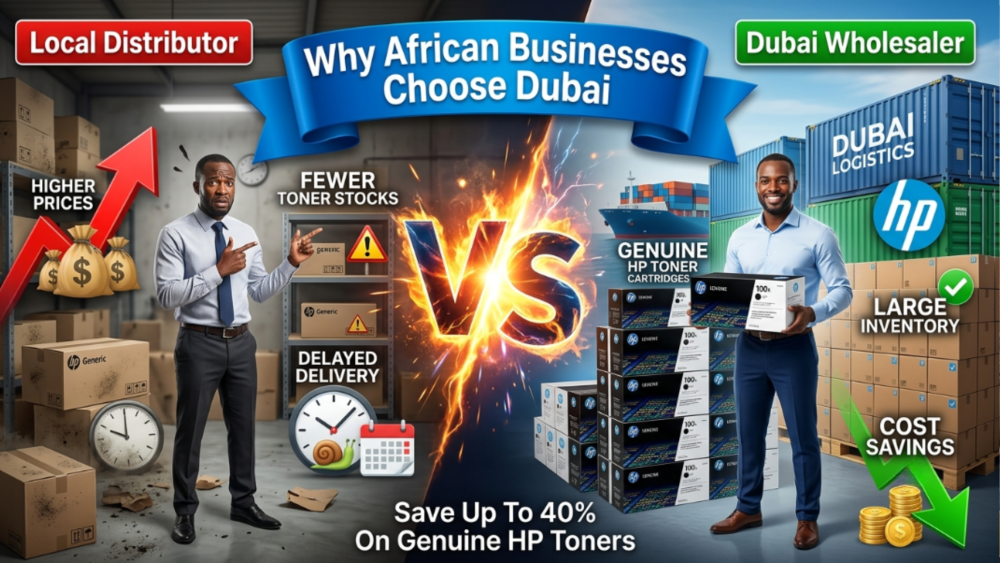
Somewhere between the HP factory and the shelf of a local supplier in Accra or Kampala, a toner cartridge picks up a lot of extra cost. It doesn't arrive that way. It earns it — through freight markups, importer margins, distributor fees, and whatever the retail layer decides to add on top. By the time a procurement manager in Lagos writes a purchase order, they might be paying two to three times what a buyer in Dubai paid for the same product six weeks earlier.
That gap is the reason sourcing HP toners from Dubai wholesalers has quietly become one of the more practical procurement decisions an African business can make. Not transformative. Not revolutionary. Just a straightforward cost arbitrage that more companies across the continent are acting on as they get better at international sourcing.
.png)
The Local Distributor Problem, Honestly Described
Local distributors across sub-Saharan Africa serve a real purpose. They absorb the complexity of international importing so that smaller buyers don't have to. But that service has a price, and for high-volume toner buyers, it often stops making sense.
The issue isn't one big markup — it's several small ones stacked. A regional importer brings product into, say, South Africa or the Gulf. A national distributor buys from them and sells to country-level resellers. Those resellers supply local dealers. Each link in that chain takes margin. None of them are being unreasonable by their own logic. The cumulative effect is that the end buyer — your office supply business in Nairobi, your corporate procurement team in Lagos — is funding everyone's operation simultaneously.
Inventory depth is a related problem. Local distributors tend to stock conservatively because carrying inventory costs money. That's sensible for them and frustrating for buyers who need a specific cartridge model that isn't one of the top five sellers. "We can order it in" is a sentence procurement managers hear too often, usually when something has already run out.
And counterfeit product remains a genuine issue in African markets. Not at every supplier, not even at most — but enough that buyers who've been purchasing toner long enough have almost certainly received non-genuine stock at least once, often without realizing it until something went wrong with a printer. Genuine HP toner distributors with verifiable supply chains aren't universally available at the local level.
Why Dubai Specifically
The UAE didn't stumble into being a global distribution hub. It was built — Jebel Ali Free Zone, liberalized re-export rules, aggressive port infrastructure investment, favorable tax treatment for goods in transit. The result is a trading ecosystem where HP toner suppliers in Dubai operate at volumes that simply don't exist in most African domestic markets.
Volume matters here because it determines what pricing is even possible. A Dubai wholesaler moving container loads of wholesale printer cartridges from UAE to buyers across three continents can negotiate pricing and freight rates that a national distributor in Kenya, working at a fraction of that scale, structurally cannot. That's not a criticism of local suppliers — it's arithmetic.
The free zone structure is worth understanding too. Goods imported into Jebel Ali for re-export don't attract UAE customs duty. That's a real cost that doesn't get added to the product before it ships to you. Combined with competitive sea freight rates on well-established Dubai-to-Africa routes, sourcing HP toners from Dubai wholesalers lands product at a total cost that routinely beats local distributor pricing by 30–40%.
Dubai also sits at a useful geographic intersection. The shipping lanes connecting it to Mombasa, Dar es Salaam, Lagos, Tema, and Durban are mature, well-serviced, and competitively priced. This isn't a market where you're pioneering a new trade route — you're joining one that thousands of importers across Africa are already using.
What the Numbers Actually Look Like
Abstract percentages are easy to ignore. Concrete numbers are harder.
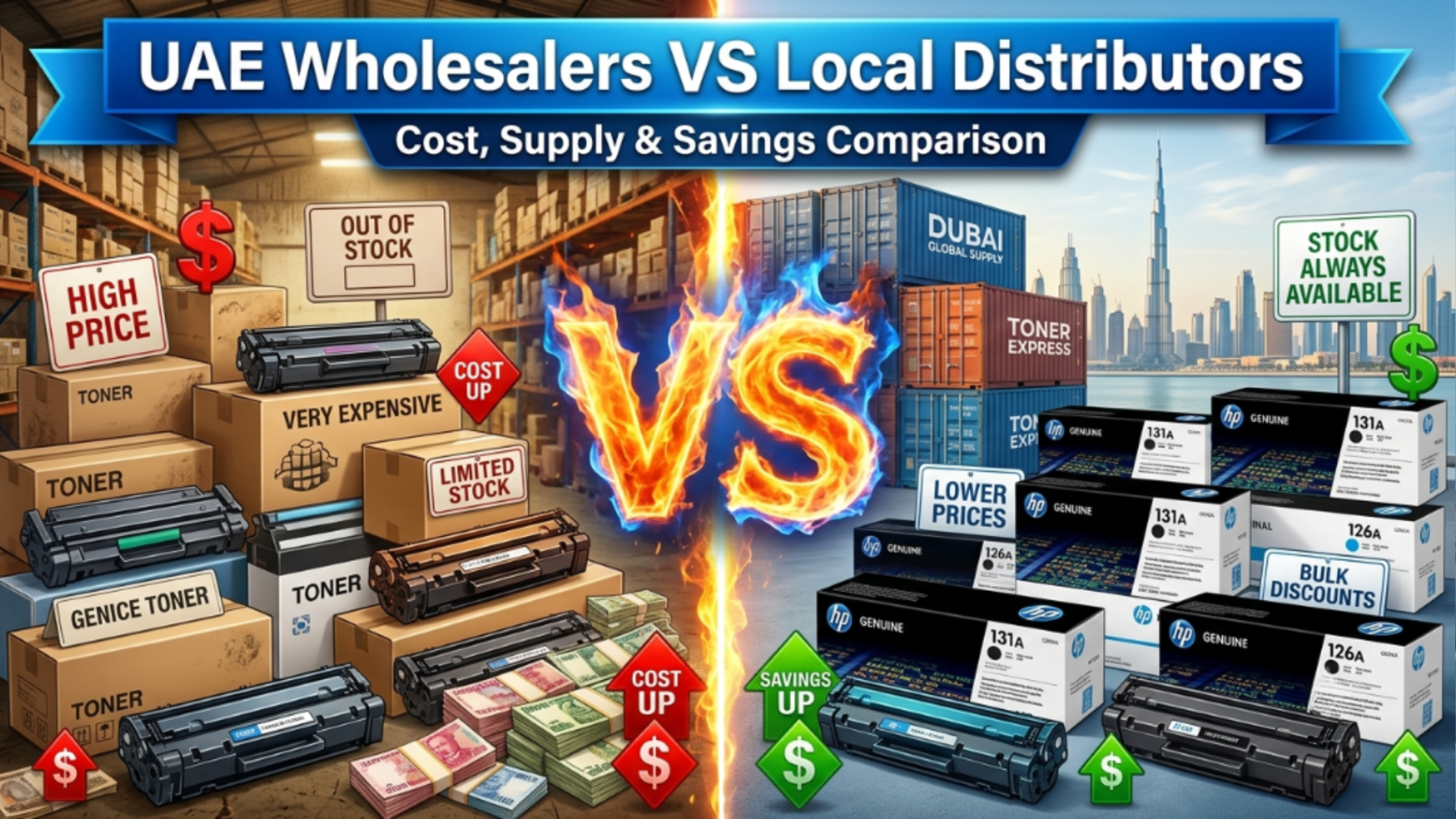
Take the HP CE505A — the 05A black toner, widely used across LaserJet P2035 and P2055 series printers that are common throughout African offices. A local distributor in Nigeria or Kenya typically prices this between $35 and $48 per unit. Sourcing HP toners from Dubai wholesalers, the same genuine cartridge — including sea freight to Lagos or Mombasa — typically lands at $20–$28 per unit, depending on order volume and current freight rates.
On 80 units a month, that's a saving of somewhere between $1,100 and $1,600 monthly. It's $13,000 to $19,000 annually from a single SKU. For a reseller carrying a full range of HP cartridge models, the aggregate saving across their product mix is substantially larger.
Bulk toner purchase from Dubai suppliers also structures differently from local wholesale pricing. Tiered pricing — where the per-unit cost decreases as order size increases — is standard among genuine Dubai wholesalers. Most African distributors apply relatively flat pricing regardless of order size. The economics of bulk commitment are simply more favorable on the Dubai side.
Getting Product from Dubai to Your Door
The logistics of toner export to Africa from Dubai are, in practice, less complicated than they appear to buyers who haven't done it before. Sea freight from Jebel Ali to East African ports runs 7–14 days. West African ports — Lagos, Tema — add roughly a week. These timelines are consistent enough to build an inventory cycle around.
For buyers not yet at container volume, freight consolidation solves the access problem. You share container space with other importers, your per-kilogram freight rate drops significantly, and you don't need to be moving twenty pallets to access competitive pricing. Several freight forwarders specializing in Dubai-to-Africa routes offer this as a standard service.
Air freight is real and usable for urgent restocking. Direct cargo connections between Dubai and Nairobi, Lagos, Accra, and Johannesburg keep delivery windows tight — three to five days is achievable. The per-kilogram cost is higher, but on a per-cartridge basis for a compact product like toner, it's not prohibitive for emergency orders.
The customs documentation side — commercial invoices, certificates of origin, packing lists — is handled routinely by experienced Dubai exporters who ship to African markets regularly. They know the HS codes, the duty structures, and the specific documentation requirements for different countries. Working with a supplier who has established export experience to your target country removes most of the friction that first-time importers encounter.
Finding Wholesalers Worth Trusting
Sourcing HP toners from Dubai wholesalers delivers on its promise only if the supplier is legitimate. The Dubai wholesale market includes authorized distributors with direct HP supply chain relationships, and it includes intermediaries adding another layer to the same cost structure you were trying to avoid. Telling them apart takes a bit of effort.
Ask for HP authorization documentation. Affordable HP toner suppliers who are properly positioned within HP's distribution channel will have current certificates. Any wholesaler who deflects this question or provides documentation that looks vague or unverifiable deserves skepticism.
Check their trade license through the Dubai Chamber of Commerce or the relevant free zone registry. A legitimate, operating business has a current license. It takes five minutes to check and gives you baseline confidence before committing capital.
Request samples before a first large order. Reputable bulk toner purchase Dubai suppliers accommodate sample requests without drama. Test the cartridges on your actual printer models. Check yield against the specified page count. Observe chip behavior. A supplier confident in their product will encourage this.
MOQ flexibility tells you something about who a supplier is designed to serve. A wholesaler with a 500-unit minimum per SKU is built for enterprise buyers. If your monthly volume per cartridge model runs 50–150 units, there are suppliers whose minimums and pricing structure fit that reality. Don't force a mismatch because the unit price looks appealing — overshooting your inventory capacity has its own cost.
Where Buyers Go Wrong
The most common mistake is treating the product price as the total cost. It isn't. Import duties, port handling fees, clearance costs, inland transport — all of these add up and vary by destination country. A quote that looks 40% cheaper than your local supplier can narrow considerably once the full landed cost is calculated. Always build the complete picture before comparing.
Skipping product verification is another one. HP's online authentication tool exists specifically for this purpose. Use it on any new supplier's samples before placing a large order. Counterfeit HP toner does move through Dubai's wholesale market — mainly through less reputable intermediaries — and it's not always identifiable by packaging alone.
Lead time planning is a failure mode that tends to be obvious only in retrospect. Sea freight takes weeks. Customs clearance can add days. Businesses that run lean on inventory and react to shortages rather than anticipating them end up paying air freight rates that offset a significant portion of the wholesale savings they'd accumulated. Build your buffer stock, especially in the early months of a new supply relationship while you're calibrating cycle times.

The Practical Reality
Sourcing HP toners from Dubai wholesalers is, at its core, a decision about how much margin you want to leave on the table. The supply chains exist. The freight routes are established. The savings are real and documented by businesses across Kenya, Nigeria, Ghana, Tanzania, Uganda, and South Africa that made this shift and didn't reverse course.
What it requires is treating procurement as something worth optimizing — not just a logistics function that runs in the background until something breaks. For businesses spending meaningfully on HP toner month after month, that optimization has a clear and calculable payoff.
Run your own numbers. Talk to two or three Dubai suppliers. Request samples. Calculate your actual landed cost. The decision tends to get easier once you've done the arithmetic.